Crypto trading has always been fast, volatile, and highly emotional. Prices can move sharply within minutes, news spreads instantly, and traders often struggle to react in time. This is where AI tools are beginning to reshape how crypto trading works.
Artificial intelligence is no longer limited to research labs or big financial institutions. Today, AI-powered tools are widely used by retail traders, hedge funds, and crypto platforms to analyze markets, manage risk, and automate decisions.
This article explains how AI tools are changing crypto trading, what they do well, where they fall short, and what traders should realistically expect.
The Rise of AI in Crypto Trading
I still remember when crypto trading felt like pure chaos. Charts everywhere, Twitter screaming, and me thinking I had it figured out. I didn’t. Not even close.
Back then, AI crypto trading was mostly a rumor unless you were a hedge fund. Today? This is becoming a feature in almost every serious trading platform.
Why Crypto Was Perfect for AI
Crypto markets have all the ingredients AI loves:
- Extreme volatility
- 24/7 trading with no market close
- Massive streams of real-time data
- Emotional human behavior
Machine learning crypto models thrive in this environment. People get tired. Algorithms don’t.
From Basic Bots to Intelligent Systems
Early trading bots were rule-based—simple if-then logic. And wow, they failed hard when conditions changed.
Modern AI trading tools now use:
- Predictive analytics crypto models
- Neural networks that detect hidden patterns
- Continuous learning from new market data
This shift changed everything.
What Actually Changed for Traders
Here’s what I noticed first:
- Faster trade execution
- Less emotional decision-making
- More consistent strategies
- Fewer “panic” trades
But here’s the mistake I made early on. I trusted the AI too much.
AI systems are only as good as their data. Bad data leads to bad trades. I learned that the expensive way.
Key Takeaway
AI isn’t replacing traders. It’s replacing bad habits. And honestly, that’s a good thing.
AI Trading Bots and Automated Strategies
My first experience with an AI trading bot was a mess. I plugged it in, set aggressive parameters, and walked away like I’d cracked the code. Came back two days later to a portfolio that looked like it had been through a blender. Lesson learned.
AI trading bots today are way more advanced than those early disasters. Modern automated crypto trading systems use machine learning models instead of fixed rules. They analyze price action, volume, volatility, and even market sentiment before executing trades.
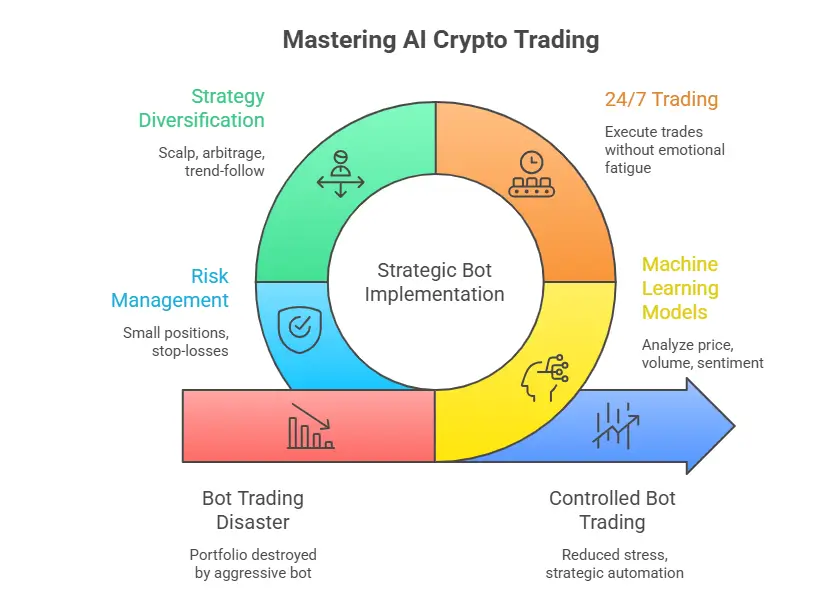
The big advantage? Bots don’t sleep. Crypto markets never close, and human traders absolutely do. AI trading software can scalp, arbitrage, or trend-follow 24/7 without emotional fatigue.
Scalping bots hunt tiny price movements. Arbitrage bots exploit price differences across exchanges. Trend-following algorithms ride momentum until the data says stop. Each strategy has strengths—and risks.
What AI Trading Bots Actually Do?
AI trading bots analyze:
- Price action and volume
- Order book depth
- Volatility patterns
- Market momentum
Then they execute trades based on probability, not emotion.
Common AI Trading Strategies
Most automated crypto trading strategies fall into a few categories:
- Mean reversion strategies – trade price extremes
- Scalping bots – small, frequent profits
- Arbitrage bots – exploit price gaps across exchanges
- Trend-following algorithms – ride momentum
Each one works… until it doesn’t.
Where Traders Mess Up
Here’s what I see all the time:
- Overleveraging automated trades
- Running bots without stop-loss rules
- Ignoring changing market conditions
AI crypto trading bots don’t “know” when news hits. They react after.
How I Use Bots Now
These days, I treat bots like tools, not saviors:
- Small position sizes
- Conservative risk limits
- Manual oversight
Automation should reduce stress, not multiply it.
Predictive Analytics and Market Forecasting
Predictive analytics was the part of AI crypto trading that hooked me. The idea that algorithms could forecast price movements felt unreal. But after watching models correctly anticipate volatility spikes, I was convinced… cautiously.
AI crypto prediction models analyze massive datasets—historical prices, order flow, funding rates, on-chain metrics, and even social media sentiment. Neural networks and deep learning systems look for correlations humans miss.
Sometimes it works beautifully. AI bitcoin trading models can flag trend reversals before momentum indicators flip. AI altcoin trading tools can detect accumulation phases early. It feels like cheating.
But let me be honest. Crypto markets are weird. Irrational. Narrative-driven. One tweet can wreck the cleanest predictive model. AI forecasting isn’t prophecy—it’s probability.
How AI Predicts Crypto Markets
AI forecasting models analyze:
- Historical price data
- Volume spikes
- On-chain metrics
- Crypto sentiment analysis
Neural networks don’t predict certainties. They calculate probabilities.
When AI Forecasts Work Best
I’ve found AI crypto predictions shine during:
- High-liquidity markets
- Strong trends
- Volatility expansions
They struggle during sudden narrative shifts.
My Biggest Forecasting Mistake
I once followed an AI signal blindly. No confirmation. No risk control. Bad idea.
Now I use AI market predictions to:
- Identify potential setups
- Confirm trend strength
- Manage risk exposure
AI is a compass, not a crystal ball.
Emotion-Free Trading and Risk Management
Emotion ruined more of my trades than bad analysis ever did. Fear during dips. Greed during pumps. Revenge trading after losses. Sound familiar?
AI removes that nonsense. Emotion-free trading is one of the biggest advantages AI brings to crypto markets. Algorithms don’t panic sell. They don’t FOMO buy. They follow data.
AI-driven risk management tools automate stop-loss placement, adjust position sizing, and rebalance portfolios based on volatility. During flash crashes, these systems react faster than any human could.
That said, AI risk management crypto systems only work if configured properly. I once set overly tight stop-loss rules and got chopped to death in sideways markets. Painful lesson.
Good AI tools adapt. They widen stops during volatility spikes and tighten during calm periods. They manage downside exposure better than gut instinct ever could.
Emotion-free doesn’t mean risk-free. It means controlled risk. And in crypto, control is everything.
How AI Improves Risk Management
AI-driven risk management crypto tools can:
- Auto-adjust stop losses
- Scale position sizes dynamically
- Rebalance portfolios during volatility
This alone saved me countless times.
Where AI Still Needs Humans
AI can’t understand context. It doesn’t know why a market moves, only that it does.
That’s why human oversight still matters.
My Rule Now
If a strategy makes me anxious, it’s too risky. AI should reduce emotion, not hide it.
AI Tools for Retail Traders vs Institutional Traders
Let’s be real. Institutions still have better toys. Hedge funds run high-frequency crypto trading systems with custom AI models and private data feeds. Retail traders don’t get that luxury.
But the gap is shrinking. Retail crypto trading tools now include AI signals, automated strategies, and portfolio optimization once reserved for professionals. That’s huge.
The biggest difference isn’t access—it’s understanding. Institutions hire quants. Retail traders click buttons. I was guilty of that, too.
Learning how AI trading platforms work changed everything. Understanding limitations matters more than fancy features. Simpler AI tools, used correctly, often outperform complex ones used blindly.
AI is democratizing crypto trading, but only for traders willing to learn.
What Institutions Have
- Custom AI models
- High-frequency crypto trading systems
- Private data feeds
What Retail Traders Have Now
- AI crypto signals
- Automated trading platforms
- Portfolio optimization tools
The gap is shrinking, but education matters more than access.
Challenges, Risks, and Ethical Concerns
AI crypto trading has dark sides. Overreliance is real. Black-box algorithms make decisions without transparency. Data bias can skew outcomes.
Security is another issue. API keys get compromised. Bots get hacked. I’ve seen accounts drained because of poor security practices.
There’s also regulatory uncertainty. AI-driven trading strategies blur lines that regulators haven’t figured out yet. That uncertainty won’t disappear anytime soon.
AI is powerful—but dangerous if misunderstood.
The Future of AI and Crypto Trading
The future is adaptive. Self-learning models. AI integrated with DeFi protocols. Smarter portfolio management across chains.
But humans won’t disappear. The best traders will blend AI efficiency with human intuition. That balance is where edge lives.
Crypto trading in 2026 isn’t about predicting the future perfectly. It’s about managing uncertainty better than everyone else.
Conclusion
AI tools are changing crypto trading forever. Automation, predictive analytics, and emotion-free execution are reshaping the market.
But AI isn’t a shortcut. It’s a tool. Learn it. Respect it. Question it.
If you’ve tried AI crypto trading—or messed it up like I did—share your experience. That’s how we all get better.
Disclaimer: This article is for informational and educational purposes only and should not be considered financial, investment, or legal advice. Cryptocurrency involves risk, and prices can fluctuate significantly. Always do your own research and consider your financial situation before making any investment decisions.
Affiliate Disclosure: Some links in this guide may be affiliate links. If you choose to use them, I may earn a small commission at no extra cost to you. I only mention tools and platforms that are commonly used by beginners and experienced users alike.