Did you know that more than 70% of DeFi trades in 2024 were powered by liquidity pools instead of traditional order books? That’s wild! These pools have quietly become the beating heart of decentralized finance (DeFi).
Instead of waiting around for buyers and sellers like on centralized exchanges (CEXs), crypto liquidity pools let you swap tokens instantly. No middlemen, no permission needed. Just smart contracts, automated market makers (AMMs), and a crowd of people pooling assets together.
This guide breaks down everything: what liquidity pools are, how they work, the risks, the rewards, and how you can join in. If you’ve been curious about things like yield farming, liquidity mining, impermanent loss, or LP tokens, you’ll leave here with clarity.
What Are Liquidity Pools?
At the simplest level, a liquidity pool is a bunch of crypto tokens locked inside a smart contract. Think of it like a big pot of digital assets sitting on a decentralized exchange (DEX). Anyone can trade against the pot instead of waiting for another person to show up on the other side.
Traditional markets use an order book with “bids” and “asks.” That works fine when there are millions of buyers and sellers. But on early Ethereum DEXs, liquidity was thin. You’d get tons of slippage or trades not filling at all. Enter AMMs and liquidity pools.
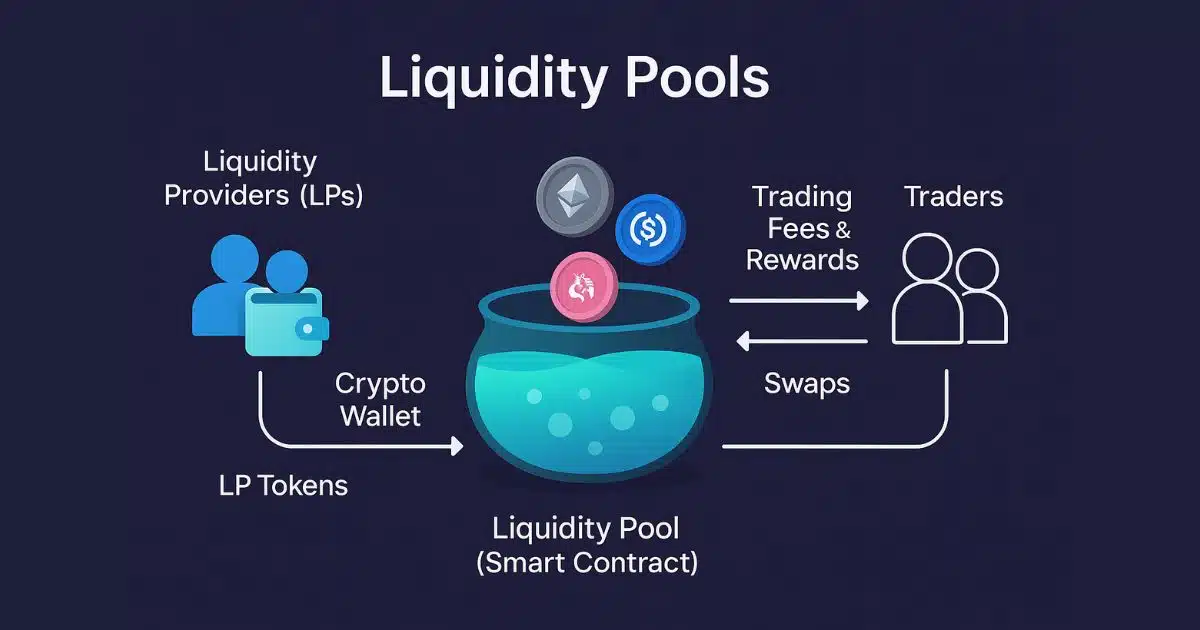
Here’s the big idea: people (called liquidity providers) deposit pairs of tokens into a pool. Other users then swap tokens directly against that pool. The protocol uses math—specifically the constant product market maker (x*y = k) formula—to keep the pool balanced.
Examples you’ve probably heard of:
- Uniswap liquidity pool (ETH/USDC, UNI/ETH)
- Curve Finance pools (stablecoin swaps)
- Balancer pools (multi-asset flexibility)
- PancakeSwap pools on Binance Smart Chain
Without liquidity pools, DEX liquidity would dry up, and crypto trading pairs would suffer. With them, markets stay liquid, fast, and decentralized.
DeFi TVL by Blockchain (2025)
To understand how liquidity pools are distributed, let’s look at which blockchains currently hold the largest share of DeFi value.
Ethereum still dominates DeFi with over 60% of total value locked, but Layer 2 chains like Arbitrum and Optimism are gaining ground.
How Liquidity Pools Work
Okay, so how does this magic happen? It all comes down to smart contracts.
A pool is coded with rules. Liquidity providers (LPs) deposit equal values of two tokens—say ETH and USDC. In return, they get LP tokens, which represent their share of the pool. These tokens are the key. You burn them later to withdraw your assets plus earned fees.
Here’s the kicker: the AMM model makes sure trading works even without buyers and sellers. Using the x * y = k formula, it constantly adjusts prices as trades happen. Let’s say Bob swaps a big chunk of UNI for ETH. The pool balance shifts, ETH gets more expensive, and UNI gets cheaper. Arbitrage traders then jump in to bring the pool back in line with the global market.
Different protocols tweak this formula:
- Uniswap v2 uses the constant product model.
- Curve optimizes for stablecoins with minimal slippage.
- Balancer allows multiple tokens and custom weightings.
LPs earn their cut from transaction fees every time a trade runs through their pool. Sometimes, they also earn extra tokens in liquidity mining programs. Those rewards can be staked elsewhere for even more yield—hello yield farming!
But remember: the system isn’t bulletproof. With great rewards come risks.
Benefits of DeFi Liquidity Pools
So why should anyone bother with liquidity pools instead of just holding tokens? Three words: passive income crypto.
- Always-on trading – No need to wait for order books. You can swap instantly.
- Lower slippage – Especially in deep stablecoin pools like Curve.
- Earn rewards – LPs get a share of transaction fees, and sometimes governance tokens too.
- Democratized market-making – In TradFi, only institutions act as market makers. In DeFi, anyone with tokens can.
It’s like Airbnb but for market-making. You’re letting people “rent” your liquidity, and in return, you get paid.
And let’s be real—many folks love DeFi liquidity tokens because they stack opportunities. You can:
- Provide liquidity on Uniswap
- Take your LP tokens to Yearn.finance
- Auto-compound yields across multiple pools
It’s a buffet of earning options.
DeFi TVL by Sector (2025)
This demonstrates how liquidity pools fuel everything from crypto trading pairs to DeFi staking pools.
Risks of Liquidity Pools
Here’s where things get tricky. Liquidity pools aren’t free money machines. They come with risks:
- Impermanent loss – Imagine you provide ETH and USDC. If ETH moons in price, your pool balance shifts, and you might have been better off just holding ETH. It’s “impermanent” because prices can rebalance, but it stings.
- Smart contract bugs – If there’s a flaw, hackers can drain millions. It’s happened before. Audits matter.
- Market volatility – Huge swings mean huge risks. Thin pools can wreck you with slippage.
- Rug pulls – Scammy projects set up fake pools, then vanish with your crypto. Ouch.
- Regulatory risk – Governments are eyeing DeFi liquidity closely in 2025.
Rule of thumb: never invest more than you can lose. And always, always research the protocol.
Liquidity Pools vs. Traditional Finance
Here’s a fun comparison.
- On a centralized exchange (CEX), a company controls the order book. You rely on them for matching trades. They hold your assets.
- In DeFi liquidity pools, you trade directly against a pool of assets. It’s peer-to-peer, non-custodial, and permissionless.
Traditional market makers are pros with deep pockets. In DeFi, anyone with $100 can be a market maker. That’s revolutionary.
Of course, TradFi has stability, while DeFi pools can get wild with volatility and risks. But the innovation is undeniable.
Popular picks include Uniswap, Curve, Balancer, PancakeSwap, SushiSwap.
MetaMask for Ethereum, or TrustWallet on BSC. Double-check links to avoid phishing scams.
Example: ETH/USDC. Some pools require equal values of each asset.
Confirm the transaction, pay gas fees, and boom—you’re in.
In return, you’ll receive LP tokens. These tokens are your key to withdrawing funds later and earning a share of the fees. Some even let you stake them for extra yield (DeFi staking pools).
Pro tip: always check pool depth before joining. Shallow pools = more slippage and risk.
Future of Liquidity Pools in 2025 and Beyond
Where are we headed? Liquidity pools keep evolving fast.
- Concentrated liquidity (Uniswap v3) – LPs can choose price ranges, boosting rewards.
- Cross-chain liquidity pools – Imagine swapping ETH for SOL seamlessly. That’s coming.
- Institutional adoption – Hedge funds and big players are testing DeFi market making.
- Scalability upgrades – Layer 2 solutions (Arbitrum, Optimism) cut gas fees.
The future looks bright but also more complex. If you’re new, keep learning and start small.
Conclusion
Liquidity pools flipped the script on trading. They let anyone provide liquidity, earn rewards, and support the DeFi ecosystem. They solved the old problem of illiquid markets and gave birth to yield farming, crypto arbitrage, and liquidity mining.
Still, the risks are real. Impermanent loss, smart contract bugs, and rug pulls can wipe you out. That’s why understanding how crypto liquidity works is essential before diving in.
Start small. Pick solid protocols. Learn the ropes. And maybe—just maybe—you’ll find liquidity pools are your ticket to earning steady passive income in crypto.
👉 What’s your experience with liquidity pools? Drop your thoughts in the comments—I’d love to hear them!
FAQs:
What is a liquidity pool in crypto?
A liquidity pool is a collection of cryptocurrencies locked in a smart contract that traders can use to swap tokens on a decentralized exchange (DEX). Instead of matching buyers and sellers like traditional order books, liquidity pools rely on automated market makers (AMMs) to keep trades running smoothly.
How do liquidity pools work?
Liquidity providers deposit pairs of tokens (like ETH and USDC) into a pool. In return, they get LP tokens representing their share. When trades happen, fees are distributed back to LPs. The pool’s price balance is managed by algorithms like Uniswap’s constant product formula (x * y = k).
What’s the future of liquidity pools in 2025?
Expect innovations like concentrated liquidity, cross-chain pools, and growing institutional adoption. Liquidity pools will likely get more efficient, safer, and integrated into mainstream finance.
Sources & References
- Uniswap Docs – What is a liquidity pool; constant product formula and pools of ERC-20 tokens on Uniswap. Uniswap Docs
- CoinMarketCap – Impermanent loss: definition, how it occurs, and how to reduce its impact. CoinMarketCap
- CoinTracker – Understanding impermanent loss and crypto liquidity risks. CoinTracker
- CoinTelegraph – Explanation of impermanent loss via examples and risk management. Cointelegraph